


Behind the Pour: Inside a Big Bear Candles Production Day

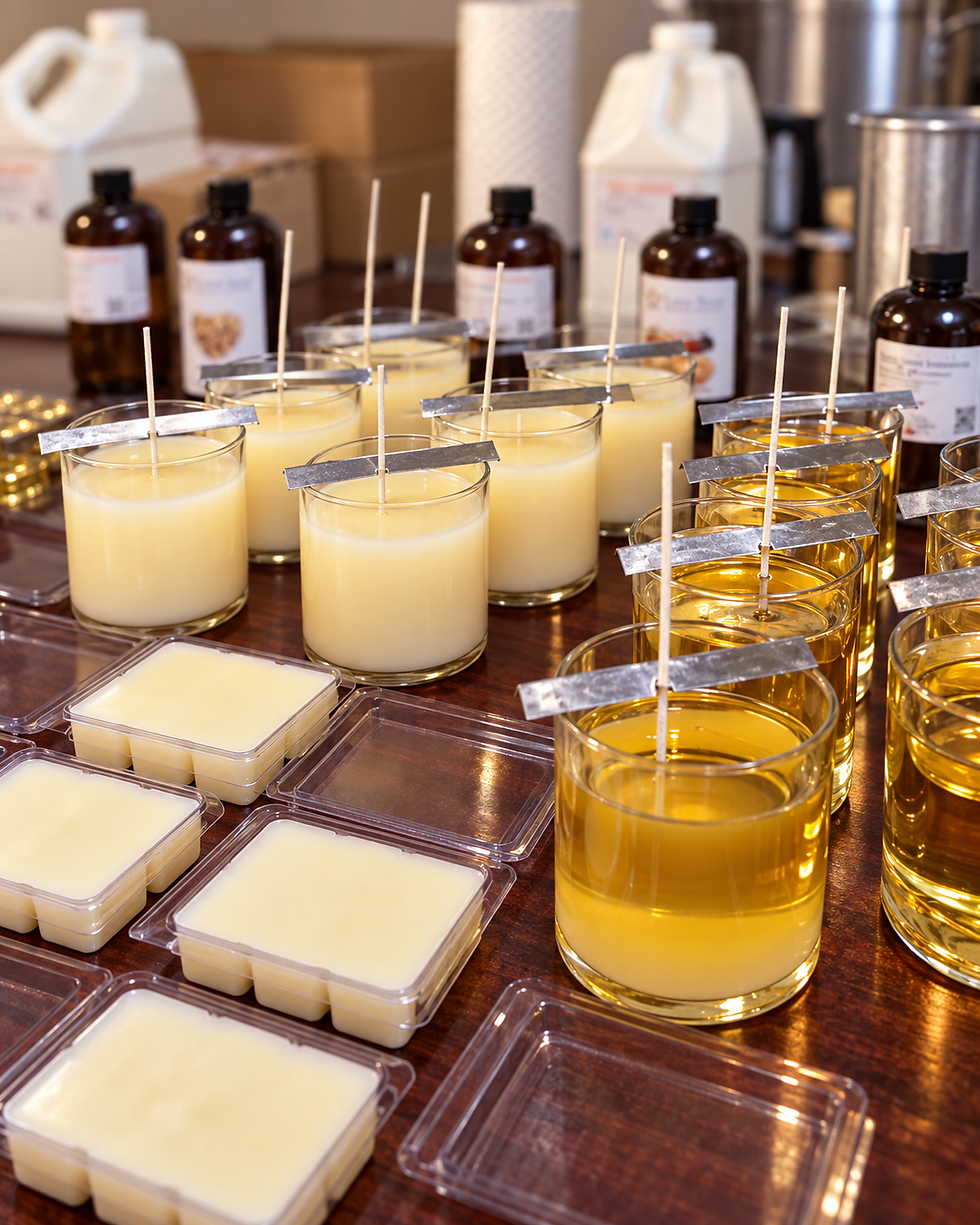
Before a candle has a lid, a label, and a place on your shelf, it has a place on the worktable. Our production photographs show that part of Big Bear Candles: rows of clear jars, wicks standing above their rims, metal bars resting across the tops, and wax at different stages of cooling. Alongside them sit fragrance bottles, pouring pitchers, and open wax melt packages.
It is a different view from a finished product photograph. Here, the interesting details are the ones normally hidden by the finished candle. Look closely and you can follow several parts of the process across a single table. This is a tour of those details, and of the decisions that connect a prepared jar with the candle you bring home.
Read the worktable from empty jars to filled candles
In the first worktable view, empty jars form one row while filled jars occupy another. The empty ones already have their wicks in place. Nearby, the warmer-looking wax appears transparent and golden; elsewhere, filled jars look creamy and opaque. The photographs capture work in progress rather than a display arranged only to show finished products.
The pictures are not a stopwatch or a complete production log. They cannot tell you a batch's precise temperature, how long it has rested, or which fragrance belongs to every jar. What they do show is the physical setup: products being prepared, filled, and left to set. Understanding those visible details makes the work behind a small-batch candle easier to appreciate.

The wick is part of the setup from the beginning
An unfilled jar can look like an unfinished object, but there is already an important component inside it. At the bottom sits the wick assembly; the wick extends up through the center of the vessel. Preparing that arrangement before filling allows the candle to take shape around the wick.
Across many of the filled jars, you can see a narrow metal bar resting on the rim. These bars help hold the wicks in position while the wax sets. They are production tools, not part of the finished candle. The long lengths of wick above them also belong to this stage of the work. They should not be mistaken for a recommendation about how long to leave a wick when lighting a candle at home.
For the customer, this is a useful reminder that a candle is a combination of parts. The fragrance may be the first thing you choose, but the wick and vessel have practical jobs too. The finished product needs those parts to work together.
A closer look at the golden wax
One photograph moves the focus away from the jars and toward the large metal pot in the foreground. Inside is a pool of golden liquid, with metal pitchers visible behind it. This is the part of the production series that most clearly shows wax before it takes the familiar shape of a candle.
Liquid and solid wax can look very different. In these photographs, the transparent gold and pale cream create a striking contrast. Lighting, the depth of the wax, and the fragrance formulation can all affect the appearance, so color alone is not a reliable way to identify a scent or judge how a finished candle will perform.
The pot also gives a sense of the practical work involved. Before there is a neat row of candles, there are materials to handle and vessels to fill. A finished jar hides most of that equipment. Seeing it makes the transition from raw material to home fragrance much more tangible.

Fragrance choices begin before the label goes on
The amber bottles along the worktable are another clue to the range of fragrances behind the finished collection. A row of similar-looking candles can become very different experiences once you start reading the scent descriptions.
Take Buttercream Vanilla and Sweater Weather. Buttercream Vanilla follows a sweet bakery direction with butter and vanilla. Sweater Weather combines mandarin, cedar, jasmine, sandalwood, amber, and dark musk. Both can suit a comfortable evening at home, but they approach that feeling differently.
Choosing between them is personal. Someone who wants the impression of frosting may love the first; someone who prefers woods and amber may lean toward the second. This is why a meaningful fragrance description matters more than a broad promise that every candle smells amazing. It helps you connect what is on the worktable to something you already know you enjoy.
Cooling is a visible part of the story
The photographs of pale candles next to more transparent jars show a stage customers rarely see. The surface and body of the wax are changing as the filled vessels settle into their finished appearance. The centering bars remain in place while the jars occupy their positions on the table.
A candle looking solid in a picture is not proof that it is ready for every next step. Cooling and any additional resting period are separate considerations, and the appropriate process depends on the materials and formulation. A photograph cannot establish a universal schedule.
From a reader's perspective, the useful detail is simpler: pouring does not instantly produce the finished candle in a shop photograph. There is an interval between liquid wax and the product with its lid on. The worktable needs to accommodate that interval as well as the active work of filling.
Why wax melts appear beside the candles
The open clamshell packages in the foreground contain wax melts. Their shallow compartments make them look quite different from the taller jar candles nearby. Together, the two formats show that home fragrance can leave the worktable in more than one form.
A candle has its own wick. Wax melts are used with a compatible warmer, following that warmer's directions. If you prefer fragrance without lighting a candle, an electric warmer with suitable melts offers that option. A tealight-powered warmer still uses a flame, so the type of warmer matters.
You can also use format as a practical shopping decision. Perhaps you enjoy candlelight in the living room but already use an electric warmer elsewhere. The Banana Nut Bread wax melts offer a bakery fragrance in that second format. Always check the individual listing and warmer instructions before use.
What the finished product photograph leaves out
A finished candle image helps you judge the jar, lid, label, and overall look. A production image answers a different question: what existed before that finished presentation?
Here, you can see the repetition of preparation, the room taken up by batches, and the equipment that supports the work. You can also see why one photograph cannot establish every aspect of product quality. The complete candle matters beyond its appearance. For a general explanation of how makers evaluate performance through a candle's life, CandleScience's burn-testing guide is a useful reference.
Our featured Classic candle listings describe hand-poured candles made with a coconut-soy wax blend. Individual product pages provide the relevant size and fragrance information. Those specifics are more useful when shopping than assuming every jar in a collection has the same capacity or characteristics.
Bring a little of the worktable home
The next time you take the lid off a candle, you can picture more than the finished label. There was an empty vessel, a wick positioned inside it, wax before and after filling, and a stretch of worktable occupied by the batch.
If the warm colors in these photographs have you thinking about bakery fragrances, Banana Nut Bread is a place to start. If you prefer something less dessert-like, explore Sweater Weather's wood-and-amber direction. Choose the fragrance that fits your taste, then follow the care instructions supplied with your candle.
The workroom and your home are different settings, but this is the connection between them: the objects taking shape on that table become part of the atmosphere you choose for your own space.
Photography note: These images were edited from our production photographs to improve lighting and presentation.


Comments